



Published on : 09/15/2026
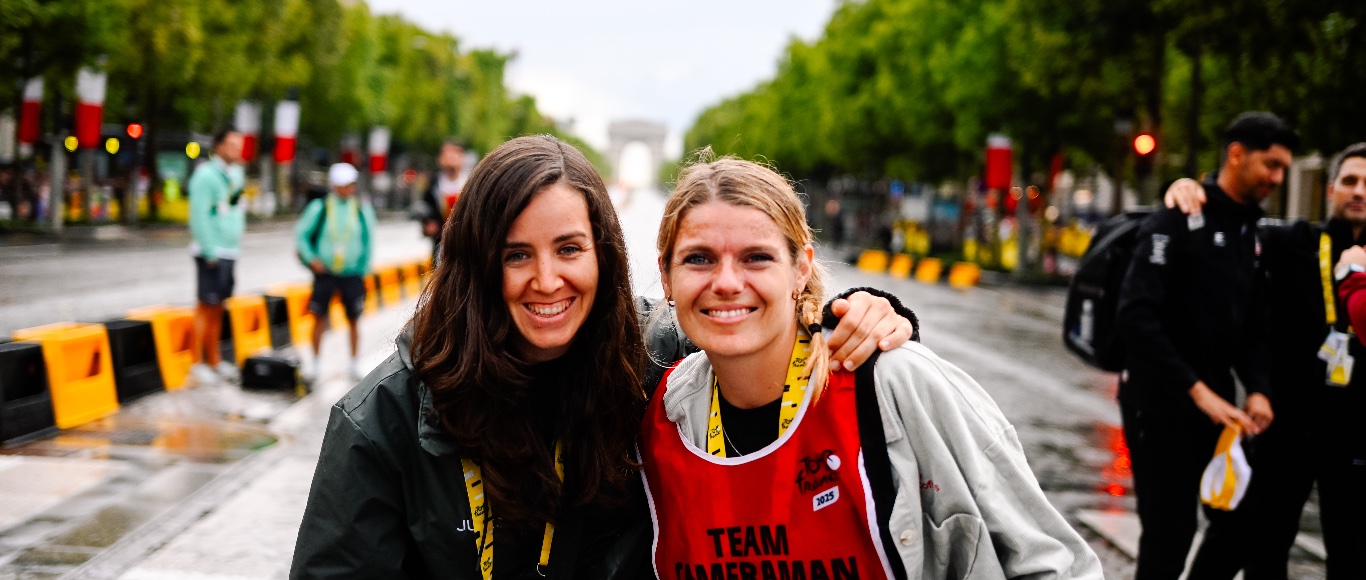
At lunchtime, the Cofidis team takes a moment to chat with the people who make up the team. With “A l’abri du vent”, we put the race to one side for a few minutes to listen and take our time. Today, let’s meet Mathilde L’Azou.
Your career path is quite extraordinary. How did it all begin?
Very early on. At the age of 14, I covered my first Tour de France… as a journalist.
I’d won a competition that allowed six young people aged between 14 and 16 – from France, Belgium and Luxembourg – to follow the Tour as young reporters. There were written exams, tests and interviews in Paris. And once I’d got my foot in the door, I never really left.
From then on, everything fell into place. I carried on working for a website from my teenage years onwards, I took up photography, I passed my A-levels at 16, then went straight into journalism school. At 19, France TV Sport offered me a contract straight after I finished my studies.
For the past ten years or so, I’ve been on the road as a photographer, journalist, community manager and commentator. Still in sport, 90 per cent of the time.
What exactly are your roles these days?
I am a photographer and community manager for the Cofidis team.
I also work for the French Athletics Federation and for (OC Sport) on triathlons and running events in Switzerland and north-west France. I am also a TV commentator for France 3.
And I’m in charge of communications for the Chrono des Nations.
That’s a lot of different roles, but they’re all areas I’m deeply passionate about.
How did you end up at Cofidis?
It wasn’t originally part of the plan. With France TV Sport, I was due to produce a series following Cofidis throughout the season, culminating in the Tour de France. I was in charge of this project.
So I’d turn up at the training camps in December and January with a film crew. And at the same time, I’d also bring my camera along to take a few snaps. That’s how I met Florent Poleyn. He saw how I worked, my versatility, and things just fell into place naturally. In 2018, I officially joined the Cofidis team.
Did you ever imagine you’d be doing this job at such a young age?
Not really. At 14, I hadn’t had time to ask myself that sort of question. I loved drawing, I was drawn to fashion design, and I also thought about becoming a teacher. But journalism is something that has always intrigued me.
Over time, I’ve honed my eye. I taught myself photography and developed my own style. Community management came later, almost naturally, as social media evolved.
At France TV Sport, I launched the first Snapchat Stories and the first Facebook Live streams. I was sent to events like Paris–Roubaix or the Olympic Games as a sort of trial run: if it worked, we’d carry on.
What motivates you on a day-to-day basis?
Telling a story.
Highlighting people, not just for their performance, but for who they are. We don’t all see a victory, a defining moment or an emotion in the same way. And I think it’s important to be able to recount these moments in my own way.
Being there to witness major sporting events is a privilege. Recounting them with sincerity is a responsibility.
In practical terms, what is your role in a race like the Tour de France?
Before the race, I soak up the atmosphere: the team waking up, the smiles, the kit, the host city. I quickly send content to the communications team, who are working remotely.
At the start, I carry on capturing the riders signing autographs, moments on the team bus, the ‘behind-the-scenes’ action. I like to show what the public doesn’t see: the funny moments, the moments of concentration, the little rituals.
After that, I often head to a feed zone, then to the finish line. And there, you can’t afford to miss a beat. A victory, an attack, a disappointment… The emotions are raw.
The work doesn’t stop at the finish line. Back at the hotel, I sort through the photos, edit them, send them to the riders and partners, and publish content for Cofidis. The days are long, but I like being in control of what I’m telling and how I’m telling it.
What sort of relationship do you have with the runners?
A relationship built on trust.
I need to be approachable without being intrusive. I have no role in the sporting strategy, so they can talk to me freely – about their families, their doubts, anything and everything.
The December training camps are essential for building this bond, especially with the new recruits. They get to see how I work, and realise that I know how to be patient, listen and show respect.
Any particularly memorable moments at Cofidis?
There have been several, but one week stands out in particular.
On Saturday, Victoire Berteau became French champion in Cassel. I had a feeling right from the morning that something was going to happen. When she won, there was an explosion of joy. We all celebrated together.
A week later, Victor Lafay won a stage at the Tour de France. I was right behind the finish line; I hadn’t even realised he’d won. And then, ten days later, Ion claimed victory in his turn.
Moments like those stay with you for life.
What do you want people to understand about your profession?
It’s not just about pressing a button. Anyone can take a photo. Being a photographer means looking for an angle, an emotion, a certain light. It involves retouching, harmonizing, and storytelling. There is a whole world of unseen work often late into the night that goes into producing images that will become memories. And that isn’t always visible.
How do you manage your personal life with this pace?
It’s not a conventional balance. For a long time, I said yes to a lot of things because I needed to make a name for myself. Now, I’ve found a happy medium. I know more or less where I’ll be at any given time of year: July for the Tour, April for the Classics, May in Brittany. And sometimes there are surprises unexpected projects. They are sacrifices, but ones I’ve chosen to make. I’d rather experience what I love than regret not having taken the leap.
Did starting so young ever scare you?
No. I’m quite naive in the good sense of the word. If I had dwelled too much on the risks, I wouldn’t have done anything. The more afraid I am, the more I tell myself it’s probably the right direction. Asking questions at a press conference in front of 300 journalists when you’re 14 is intimidating. But if you wait until you’re no longer afraid, you never move forward.
What message would you like to convey?
Don’t be afraid to forge your own path. Not everything has to be done right away. Sometimes you need to know how to say no, wait, and keep learning. Very few people are lucky enough to do what they truly love. When you have that chance, you shouldn’t squander it even if it doesn’t look like a “normal” life.