



Published on : 04/14/2026
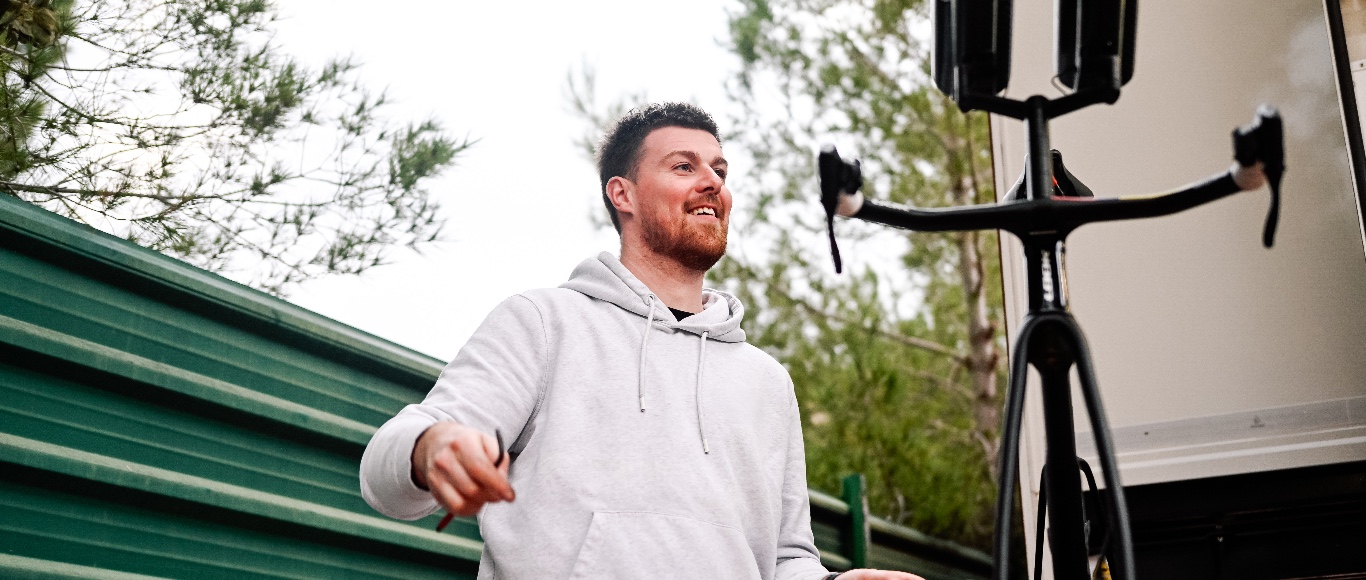
At lunchtime, the Cofidis team takes a moment to chat with the people who make up the team. With ‘A l'abri du vent’, we put the race aside for a few minutes to listen and take our time. Today, let’s meet Florent Sobolewski.
How did your cycling career begin before you joined Cofidis?
Cycling has always been a passion of mine, ever since I was a child. I did a bit of cycling when I was younger, but what really appealed to me was the mechanics. So I trained as a bicycle mechanic in Toulouse.
Once I’d got my qualification, I moved back up north and took a permanent job at a Culture Vélo shop. I was in charge of the workshop there for two years. But I soon realised that what really interested me wasn’t the shop, but the world of competitive cycling.
Alongside my job, I’d lend a hand at the Nogent-sur-Oise club at weekends, whenever I could. That gave me a foothold in the world of elite sport. Then an opportunity came up to work in Belgium, directly with the pros. I spent a year and a half there and learnt an awful lot.
When I wanted to return to France, I met Nicolas Daniel, the head mechanic at Cofidis. We hit it off straight away; he was looking for someone, and that’s how I joined the team.
Have cycling and mechanics always been central to your life?
Cycling, yes, but I’ve also done other sports. Football, motocross… To be honest, I was actually more interested in motorbike mechanics than cycling.
It was a motorbike accident that changed everything. As part of my rehabilitation, I had to cycle. I rediscovered my love of sport and physical exertion, and little by little I got back into it completely. Today, what gives me the most satisfaction is clearly my job as a mechanic in the world of competitive cycling.
I love building a bike, maintaining it, and fine-tuning it down to the last detail for performance. That’s where I get the most enjoyment.
What motivates you in your day-to-day work?
Attention to detail. I’m a very meticulous, very precise person. I always try to add that little extra touch, even if it’s not necessarily obvious to everyone.
For me, every detail counts. That’s really what drives me: knowing that everything is perfect, that nothing has been left to chance.
How do you work with the cyclists and their bikes?
Every rider already has their own very precise bike setup. Then there are performance-related requests, which go through our head mechanic. The tasks are then divided among the mechanics.
There’s also a lot of direct communication with the riders. After a training session or a race, they might come and see us for a quick adjustment: a derailleur, a saddle, tyre pressure, or a small adjustment to their position. It’s all part of the daily routine.
What is your role before, during and after a race?
This year, I was in charge of one of the team’s trucks. My role before the race is to make sure all the necessary equipment is ready: bikes, wheels, parts, tools.
Once we’re there, I take care of setting up the truck, preparing the bikes with my colleagues, cleaning the vehicles, and all the logistics. During the race, it’s often my colleagues who follow in the car to provide breakdown assistance, whilst I head to the finish line with the truck.
But I do sometimes find myself in the race car. At times like that, there’s inevitably a bit of adrenaline. When you’re starting out, there’s also a lot of stress: you’re afraid of making a mistake. With experience, that stress lessens, because you know it can make you lose your nerve.
How do breakdown repairs work during a race?
Every rider has an earpiece. We have the radio in the car. When there’s a problem, we try to get the clearest information possible: front or rear puncture, specific mechanical issue.
It saves time. In the event of a crash, we don’t even try to figure it out: we just swap the bike straight away. We have to act quickly and be sure. Riders always have at least two spare bikes, sometimes three. There’s always a solution.
Are there any particularly memorable moments in your job?
Crashes, without a doubt. When you get out of the car, you don’t always have all the information. Sometimes you see 40 or 60 riders on the ground, and you’re trying to find out if any of your own riders are among them.
You check the bike, the rider’s condition, and whether they can get back on or not. These are very intense, very memorable moments.
Your job is often seen as one that goes unnoticed. What is the one thing the public is most unaware of?
Many people think we only work during the races. The question I’m asked most often is: ‘Do you do this all year round?’
The answer is yes. It’s a year-round job, with a proper schedule, periods of work and periods of rest. The races that the public sees are just the tip of the iceberg.
We can have several races on the same day, on different continents, with different teams. Everything is planned well in advance, often as soon as the winter training camps finish.
How do you manage your work-life balance?
There’s a lot of planning involved. We have precise schedules and dates set in advance, which makes it easier to organise ourselves.
It requires flexibility, but it’s still possible to strike a balance. We manage to set aside time outside of work, provided we plan ahead properly.
What makes you think you couldn’t do a different job?
I love my job. We work with top-of-the-range equipment, in exceptional conditions. But above all, there’s the human aspect.
We sometimes spend a whole month together, far from home. Bonds form with the team, with the riders. There’s that shared goal of performance, of victory, of doing the best we can.
I’ve worked in a shop before. It’s the same world, but it’s not the same job. Here, there’s that little something extra. That passion for competition.
Honestly, I can’t see myself doing anything else.